Ads 468x60px

ShareThis

Related Posts Plugin for WordPress, Blogger...

About Me

My Photo
Marketing leader & Wharton MBA with expertise in marketing strategy, product development & innovation

Sample text

ddddddddd

Strategic Marketing Framework to print out & hang on your wall at work

I've found this framework to be immensely helpful to me throughout my career.  Particularly during those fire-fighting, short-term focused periods of work that we all experience from time to time, this framework has always helped me to reorient myself & recalibrate.     

There's a lot more to come with the framework - I'll be drilling down into the different dimensions in more detail so you can have a richer understanding for how to use it to develop robust new marketing strategies and to improve existing ones.

Please feel free to email me if you have any questions about how to put the framework to use within your business.

strategic marketing framework


Related Posts


read more

Using segmentation to develop your marketing strategy

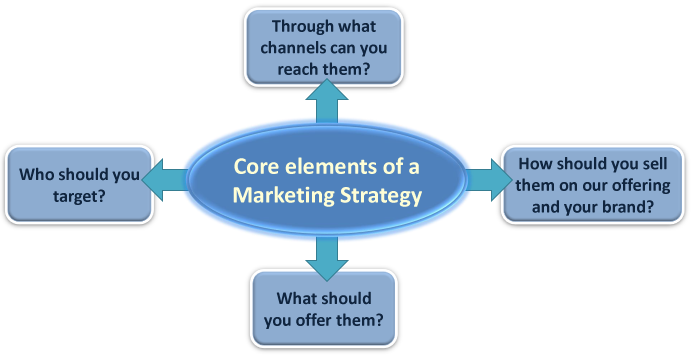
While there are many ways to harness the power of segmentation, one of the broadest and most valuable applications is for designing your marketing strategy – a strategy that clearly defines who you’re targeting, what you’re going to offer them, where you’re going to reach them, and how you’re going to sell them on your product & brand.

The key “superpower” of segmentation is that it enables you to take a population of consumers and group them based upon similarities they share with respect to the very attributes that you use to define your marketing strategy (i.e., who to target, what to offer them, etc.). What this means is that the segments you derive from the segmentation process will have their preferred marketing mixes already “baked into them”. Powerful stuff.


Segmentation for designing marketing strategies is a 2-step jig


Step 1: Identify “the who”

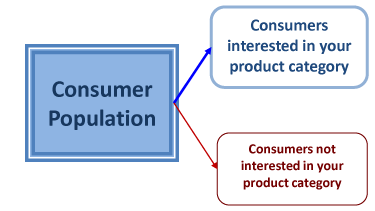
In the first step you identify “the who”. Who are those consumers in the population who have expressed interest in your product category or who have needs addressed by your product category? In this step you’re simply separating out those interested consumers from the rest of the general population.


Step 2: Identify your target segments
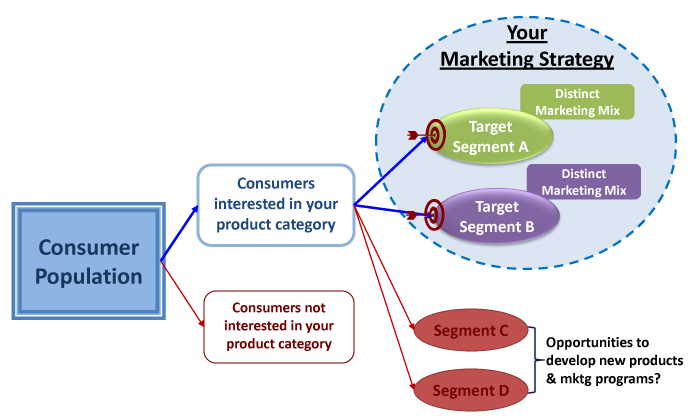
The second step is where things really get cooking. In step 2 you take the population of interested consumers and group them based upon their similarities with respect to “the what, why, where & how” of your product category.

In this step your goal is to identify the most attractive segments for your business to target – segments for which the following are true:
  • One or more of your products meet the segment’s functional & emotional needs
  • Your existing channels for selling, servicing & awareness-building align with the segment’s channel preferences and media-consumption habits
  • Your product & brand positioning align with the segment’s “reasons for buying” from both a functional and emotional perspective
  • You can identify the segment in a cost-effective manner
  • The segment is large enough in size and profit-potential to merit investment in a distinct marketing mix
By the end of step 2, you will have identified one or more segments that:
  • Are interested in one of more of your products
  • Are most effectively targeted using a distinct marketing mix
  • AND, are large enough to merit your investment in this distinct marketing mix

These segments will become your target segments and along with their distinct marketing mixes represent your marketing strategy. To reiterate from the intro, the beauty of this approach is that by basing part of your segmentation on similarities shared by consumers across key components of your marketing mix, the segments you derive come with their “marketing instructions” already included.


What about segments you choose not to target?
So what about segments that don’t meet enough of your targeting criteria? What should you do about them? The answer is that it depends.

For those segments large enough in size & profit potential you may consider developing new products, building out new channels, or creating communication strategies that better meet their needs and more effectively “speak to them”.

On the other hand, for those segments that are very small or that would require major retooling of your operations, extensive employee training, or significant stretching of your brand, you would likely leave to other companies to pursue.


More posts on segmentation & marketing strategy:


Great books & articles on segmentation:


read more

Using segmentation to develop your marketing strategy

While there are many ways to harness the power of segmentation, one of the broadest and most valuable applications is for designing your marketing strategy – a strategy that clearly defines who you’re targeting, what you’re going to offer them, where you’re going to reach them, and how you’re going to sell them on your product & brand.

The key “superpower” of segmentation is that it enables you to take a population of consumers and group them based upon similarities they share with respect to the very attributes that you use to define your marketing strategy (i.e., who to target, what to offer them, etc.). What this means is that the segments you derive from the segmentation process will have their preferred marketing mixes already “baked into them”. Powerful stuff.


Segmentation for designing marketing strategies is a 2-step jig


Step 1: Identify “the who”

In the first step you identify “the who”. Who are those consumers in the population who have expressed interest in your product category or who have needs addressed by your product category? In this step you’re simply separating out those interested consumers from the rest of the general population.


Step 2: Identify your target segments
The second step is where things really get cooking. In step 2 you take the population of interested consumers and group them based upon their similarities with respect to “the what, why, where & how” of your product category.

In this step your goal is to identify the most attractive segments for your business to target – segments for which the following are true:
  • One or more of your products meet the segment’s functional & emotional needs
  • Your existing channels for selling, servicing & awareness-building align with the segment’s channel preferences and media-consumption habits
  • Your product & brand positioning align with the segment’s “reasons for buying” from both a functional and emotional perspective
  • You can identify the segment in a cost-effective manner
  • The segment is large enough in size and profit-potential to merit investment in a distinct marketing mix
By the end of step 2, you will have identified one or more segments that:
  • Are interested in one of more of your products
  • Are most effectively targeted using a distinct marketing mix
  • AND, are large enough to merit your investment in this distinct marketing mix

These segments will become your target segments and along with their distinct marketing mixes represent your marketing strategy. To reiterate from the intro, the beauty of this approach is that by basing part of your segmentation on similarities shared by consumers across key components of your marketing mix, the segments you derive come with their “marketing instructions” already included.


What about segments you choose not to target?
So what about segments that don’t meet enough of your targeting criteria? What should you do about them? The answer is that it depends.

For those segments large enough in size & profit potential you may consider developing new products, building out new channels, or creating communication strategies that better meet their needs and more effectively “speak to them”.

On the other hand, for those segments that are very small or that would require major retooling of your operations, extensive employee training, or significant stretching of your brand, you would likely leave to other companies to pursue.


More posts on segmentation & marketing strategy:


Great books & articles on segmentation:

read more

Snapshot of some of my favorite business books

So I was in my office today and my Droid was nudging me to take a quick snapshot of a stunning view of some of my favorite business books... it's so hard to say no to a Droid...


----------
read more

Search Engine Optimization for Dummies and Dummy-Impersonators

This post is for those of you who see the acronym SEO and feel your throat tighten, your palms begin to sweat, and think to yourself, "ughhh, I know we need this SEO stuff for or to our website, I only wish I knew what SEO stood for!.." (And no, you're far from a dummy if you find SEO confusing - I used this title purely to help my Google page rank for this post ;) 

No matter how confused you ever become about Search Engine Optimization, if you remember the following you will always be able to reorient yourself and make a quick "recovery":

Google is just a librarian and SEO is simply good book labeling.
[say what?]


Google is just a librarian...
Think of Google as the head librarian of our 21st century digital library - a library filled with all the world's websites, including yours.

Google's job is simply to provide its patrons (i.e., users of its search engine) with the best information on the topics they are searching for, usually provided in the form of website links, images or videos.

For example, let's say a nice, eligible bachelor named Larry wants to find out what he can do to "tame" his fiery dragon breath and make it past date #1. Larry comes up to the library counter (i.e., www.google.com) and asks Google for information about Halitosis. Google, at lightning speed, runs to the Halitosis section of the "library", and grabs ALL of the websites on Halitosis. When Google returns to the counter, she places all of the Halitosis sites in front of Larry, sorting them from most relevant & most popular to least relevant & least popular.

That is Google's search engine in a nutshell.  (And yes, it was recently revealed by the company that Google's search engine is in fact female)


...SEO is simply good book labeling
So how does SEO come into play within this "digital library" of all the world's websites?  

Think of SEO as the process of effectively labeling & categorizing your website so that Google understands what your site is about and therefore knows when to include it as part of a person's search results.  

Going back to our Halitosis example, imagine there are 2 websites on the topic of bad breath.  Site A's name is, "How to Eliminate Bad Breath", and site B's is, "Fighting the Enemy One Brush at a Time". 

The main sections of site A (think titles of book chapters) include definitively breath-related headings like "Where bad breath comes from", "Top tips for beating Halitosis" and "Why brushing alone won't prevent bad breath".  In contrast, the main sections of site B include somewhat vague, albeit more humorous headings such as, "Readying for battle", "Exorcising your tongue", and "The war within". 

Which of these 2 websites do you think Google would rank higher on the list of Halitosis sites it returns to our eligible, yet breath-challenged bachelor?  Unfortunately it's not the site with the more creative copywriter.  Sorry. 

Google's no poet, so easy on the metaphors
While Google is one heck of a librarian, she's not a mind reader - at least not yet.  In other words, you need to be extremely clear and literal with your website content, especially when it comes to major headings & titles.  

Think of it this way - if you're thumbing through a book trying to figure out what it's about, you're most likely going to look at the book's cover, leaflets, chapter names, and index.  Google ""thumbs through" your website in much the same way.  So cute and overly metaphoric titles like "Making it to date #2"  will only help drag your site's Google ranking down... and with it, your website traffic.

Now that you hopefully have a better 50,000-foot view of SEO, below are a few resources that I've found to be particularly insightful for SEO newbies. 


GODZILLA ILLUSTRATION: TANYA DASHEVSKY
   

Additional SEO sources for beginners looking to get a little dirt on their hands
      read more