Ads 468x60px

ShareThis

Related Posts Plugin for WordPress, Blogger...

About Me

My Photo
Marketing leader & Wharton MBA with expertise in marketing strategy, product development & innovation

Sample text

ddddddddd

Want to develop great new products? Ask and ye shall receive...

As I always say, if you can't beat 'em, re-publish 'em - with the proper sourcing, of course :)   With a career that has focused deeply on product (management, marketing, development), I'd like to think I'm quite the connoisseur of the finest of writings on such topics.  Below is a terrific set of questions for getting you out of your box and into your mind's innovation lab.  The questions were first published in an HBR article in December 2007.  Enjoy.

21 Great Questions for Developing New Products
“De-average” buyers and users
  1. Which customers use or purchase our product in the most unusual way?
  2. Do any customers need vastly more or less sales and service attention than most?
  3. For which customers are the support costs (order entry, tracking, customer-specific design) either unusually high or unusually low?
  4. Could we still meet the needs of a significant subset of customers if we stripped 25% of the hard or soft costs out of our product?
  5. Who spends at least 50% of what our product costs to adapt it to their specific needs?

Explore unexpected successes
  1. Who uses our product in ways we never expected or intended?
  2. Who uses our product in surprisingly large quantities?
  3. Look beyond the boundaries of our business
  4. Who else is dealing with the same generic problem as we are but for an entirely different reason? How have they addressed it?
  5. What major breakthroughs in efficiency or effectiveness have we made in our business that could be applied in another industry?
  6. What information about customers and product use is created as a by-product of our business that could be the key to radically improving the economics of another business?

Examine binding constraints
  1. What is the biggest hassle of purchasing or using our product?
  2. What are some examples of ad hoc modifications that customers have made to our product?
  3. For which current customers is our product least suited?
  4. For what particular usage occasions is our product least suited?
  5. Which customers does the industry prefer not to serve, and why?
  6. Which customers could be major users, if only we could remove one specific barrier we’ve never previously considered?

Imagine perfection
  1. How would we do things differently if we had perfect information about our buyers, usage, distribution channels, and so on?
  2. How would our product change if it were tailored for every customer?
  3. Revisit the premises underlying our processes and products
  4. Which technologies embedded in our product have changed the most since the product was last redesigned?
  5. Which technologies underlying our production processes have changed the most since we last rebuilt our manufacturing and distribution systems?
  6. Which customers’ needs are shifting most rapidly? What will they be in five years?


Check out my favorite business books
read more

Strategic Marketing Framework to print out & hang on your wall at work

I've found this framework to be immensely helpful to me throughout my career.  Particularly during those fire-fighting, short-term focused periods of work that we all experience from time to time, this framework has always helped me to reorient myself & recalibrate.     

There's a lot more to come with the framework - I'll be drilling down into the different dimensions in more detail so you can have a richer understanding for how to use it to develop robust new marketing strategies and to improve existing ones.

Please feel free to email me if you have any questions about how to put the framework to use within your business.

strategic marketing framework


Related Posts


read more

What is customer segmentation?

Like so many buzz words in business & marketing, "customer segmentation" is one of those terms that is interpreted by folks to mean many different types of things. If the word "segmentation" were blurted out in a room of 20 business people, chances are it would conger up 20 different images. So what is customer segmentation, and how can it be used to propel one's business?


Segmentation defined
Customer segmentation is a method for grouping customers based upon similarities they share with respect to any dimensions you deem relevant to your business - whether it be customer needs, channel preferences, interest in certain product features, customer profitability, etc. The key is for you, the marketer, to first decide on what basis you wish to segment your customers (or prospects for that matter). And, the only way to answer this question is to first determine what your objective is for the segmentation, and thus what you want the segmentation to "do for you".


Common segmentation objectives
  • Developing new products
  • Creating differentiated marketing communications & ads
  • Developing differentiated customer servicing & retention strategies
  • Targeting prospects with the greatest profit potential
  • Developing multi-channel distribution strategies
Once you have decided what your objective is for the segmentation, you can answer the question, "what do I want the segmentation to do for me?"


A brief example: segmenting for customer win-backs
Let's say you worked for a subscription-based magazine such as Newsweek. Your boss has asked you to optimize Newsweek's retention strategy utilizing the current save tactic of sending people who have recently canceled their subscriptions (aka "attritors") 1 of 3 "win-back" mailers. This existing save tactic has been employed by Newsweek for the past 2 years, and the method for determining which attritor receives which mailer has been based largely on "intuition" (aka random selection).


Step 1: Your first step in undertaking this project would be to clearly state your objective. Your objective, as per your boss, is to optimize Newsweek's retention strategy for recent attritors. This is shorthand for saying, "I want you to maximize your return on your retention-dollars invested". Without getting into the nitty gritty of the approach, what you essentially want to do is determine the relative ROIs for each of the 3 mailers at the individual attritor level. For each mailer, you then want to identify those attritors with high ROIs (i.e., those attritors who re-instated their magazine subscriptions after receiving the mailer and provided you with future profits that well-exceeded the cost of the mailer).

Step 2: For each win-back mailer you want to identify those attributes which the high-ROI attritors have in common, essentially creating a profile for "high-ROI attritors" for each mailer.

Step 3: The final step is to operationalize the three profiles you've created so you can use them to determine which of the 3 mailers, if any, to send to future attritors. This essentially entails implementing a process in which new attritors are matched up against the 3 profiles to determine which, if any, best describe them. A more sophisticated approach would be to build predictive models that would calculate the expected ROI for each mailer for each attritor, and then send out the mailer with the highest expected ROI to the attritor. And, for those attritors in which all 3 mailers have negative expected ROIs you might choose not to send any win-back mailers.

Closing thoughts on segmentation
In closing, segmentation can be tricky and complex, and no doubt requires a great deal of expertise & experience. Putting in place flawed segmentation strategies can be far more detrimental to a business than not having them at all. However, when designed the right way, segmentation strategies can provide tremendous returns relative to one-size-fits-all approaches. In future posts I will tackle some other types of segmentation strategies, including those involving new product development and portfolio management. As always, feel free to email me with any of your questions, comments or thoughts. As always, feel free to email me if you have any questions about segmentation and how to most effectively use it within your business.


More posts on segmentation & marketing strategy:


Great books & articles on segmentation:


Check out my favorite business books


read more

An ode to Robert Cialdini... and another tool to print out & tape to your wall (or clip to your fridge at home)

"Influence: The Psychology of Persuasion" is one of my favorite business books of all time.  As someone who has always been fascinated by those factors that most influence behavior & decision-making, I'm naturally interested in the "art of persuasion".  Not to mention the little fact that persuasion, done well and through an ethical prism, is a key success factor for developing effective, sustainable marketing programs.

Cialdini HestonIn expressing my reverence for Mr. Cialdini while still (hopefully) providing readers with valuable marketing nuggets, I've put together a little cheat sheet of his famed laws of persuasion.  For each "commandment", I've included examples of how it is commonly employed within marketing.  However, each of these laws can be leveraged across many of life's little domains - from getting your child into that perfect school to getting bumped up to first class en route from Dallas to San Francisco.  

Enjoy, and please share your experiences with these laws - the good, the bad and the ugly.  Be they related to marketing or how you've employed them in other facets of your life.


CIALDINI LAW OF INFLUENCE MARKETING EXAMPLE
Reciprocity
You giving to me makes me really want to give back to you – I feel indebted. I owe you! Call it a form of closed-loop Karma if you like.
  • The free trial, an unexpected free gift with your purchase
  • A free whitepaper, free e-newsletter
  • Telling customers you’ve donated $15 to the charity of their choice before they’ve even completed a purchase (there are many ways to engineer this)
Scarcity
People hate to miss out on something, even if it’s something they don’t like! Human evolution made us into hoarders, and we can't seem to shake the habit.
  • The “closing window” – “last chance”, “only one week left!” “Act now while supplies last!” “Here today, gone tomorrow – don’t delay!”
  • “Limited-edition” products – art prints, coins, Barbies, Star Wars figures
Likability
We want to do nice things for people we like. We’re also more likely to trust & listen to them.

So whom do we tend to like? 1) People we have lots in common with 2) people who love to tell us how great & good-looking we are! (We just can’t get enough praise)
  • Celebrity & athlete endorsements
  • “Our product is for smart, attractive people, just like YOU!” (Oh, how I blush… keep talking!)
  • Why car salespeople try to learn early on what you both have in common. The closer you feel to her, the more you like her and are liable to trust her.
Authority
People wearing nice suits. Police officers. Firefighters. Doctors. We become zombies in the presence of such authority figures in their domains of expertise. “I’ll do whatever you say…”
  • Power of “Opinion Leaders” – featuring Consumer Reports’ positive review of your product, including an endorsement from Seth Godin on the back of your book (although he has been kind of spreading the wealth lately…)
  • Getting H&R Block to endorse your new tax software or Suze Orman to endorse your new no-load mutual fund)
Social Proof
They seem to like it, so there must be something good about it. Aka, “the bandwagon effect”, “wisdom of the crowds”.
  • Testimonials (especially from people like yourself)
  • Power of word-of-mouth, customer reviews
  • Long lines outside a night club (even though the club is often half-empty).
Consistency / Commitment
My current actions must align with my prior actions & commitments. Contradictory behavior makes me very uneasy.
  • “Foot-in-the-door” technique - getting someone to make small commitments to lead up to much bigger commitment.
  • Getting user to register for free e-newsletter or to become “fan” on Facebook before offering user fee-based offerings.
Contrast
We always evaluate our situations using some type of reference point – whether we’re evaluating the “goodness” of our incomes, spouses, children, education, etc.

Marketers & salespeople engineer reference points for you for certain purchase settings. E.g., when you’re buying a new car, the salesperson wants you to think about the $1k “option” to install heated tush warmers relative to the $40k you’re already spending for the car, and not the 3% interest you’d earn by instead putting the $1k into your savings account.
  • For only $19 you can get 6 more inches of legroom for your flight from NYC to LA! The flight’s already $450 – what’s $19 more for 5-hours of comfort?
  • “How about this nice $200 tie to go with your new $2k suit? You’re already spending $2k, why not spend a mere 10% more and make the suit perfect!”


How can I start using this information today?
  • Clarify your goal or objective.  For example, "I want to increase the ROI on my email acquisition spend" 
  • Go through each Cialdini law one-by-one and ask, "How might I use it to improve my email acquisition efforts?"  For example, for "social proof", you may decide to test the inclusion of testimonials or "seals of approval" from leading authorities within the body of your email.  For "likability", you may test emails with imagery of people who closely resemble your target market - from the clothes they wear to the surroundings in which they live.   


No Moral Judgments
A quick side note to those who feel "persuasion" is a four-letter word. To be clear, I'm not looking to generate a forum for moral soap-boxing. These laws exist whether we like it or not; a consequence of human evolution, and without their development we'd likely have gone the way of dinosaurs.  Like Cialdini, I believe these laws can be used for good, for bad, and for everything in between.  At a minimum we should all be aware of them since they do have such a profound impact on our daily lives.  Now that I got that off my chest... enjoy!

Photobucket


More from R. Cialdini plus other great persuasion content 
    read more

    Another framework to print out and put on your wall at work

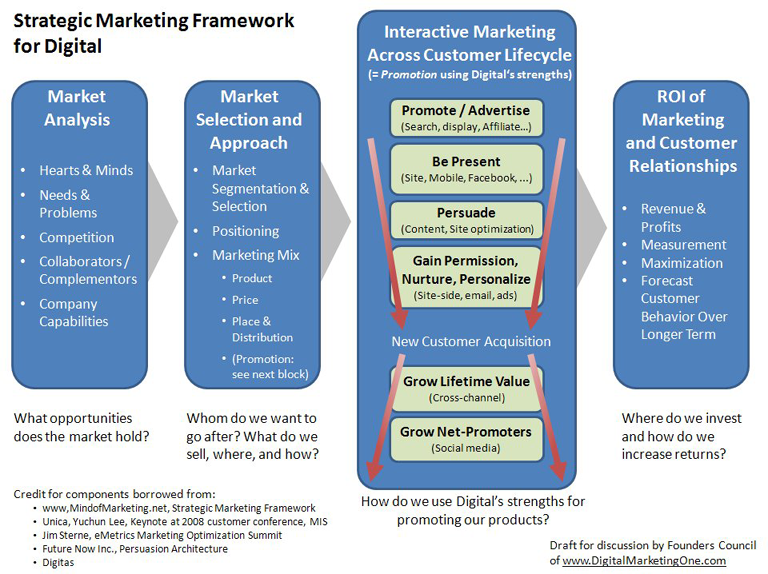
    Akin Arikan, author of Multichannel Marketing: Metrics and Methods for On and Offline SuccessMultichannel Metrics book, did a beautiful job grafting a digital/web 2.0 layer onto my strategic marketing framework. (His terrific framework is just below)


    Also, I highly recommend you read his post describing his digital marketing framework so you can get a better understand of the concepts behind it. Powerful, useful stuff.  Very nicely done, Akin!


    read more

    Strategic Marketing Framework to print out & hang on your wall at work

    I've found this framework to be immensely helpful to me throughout my career.  Particularly during those fire-fighting, short-term focused periods of work that we all experience from time to time, this framework has always helped me to reorient myself & recalibrate.     

    There's a lot more to come with the framework - I'll be drilling down into the different dimensions in more detail so you can have a richer understanding for how to use it to develop robust new marketing strategies and to improve existing ones.

    Please feel free to email me if you have any questions about how to put the framework to use within your business.

    strategic marketing framework


    Related Posts


    read more

    Using segmentation to develop your marketing strategy

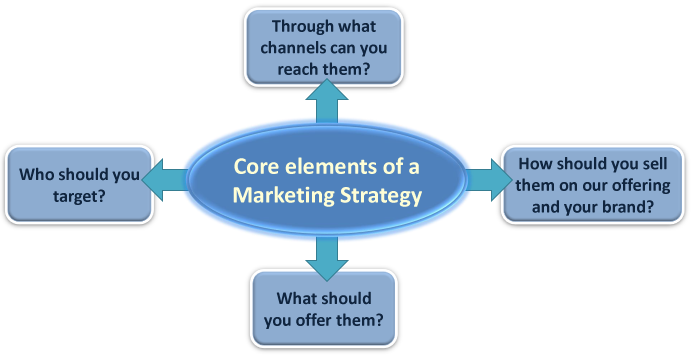
    While there are many ways to harness the power of segmentation, one of the broadest and most valuable applications is for designing your marketing strategy – a strategy that clearly defines who you’re targeting, what you’re going to offer them, where you’re going to reach them, and how you’re going to sell them on your product & brand.

    The key “superpower” of segmentation is that it enables you to take a population of consumers and group them based upon similarities they share with respect to the very attributes that you use to define your marketing strategy (i.e., who to target, what to offer them, etc.). What this means is that the segments you derive from the segmentation process will have their preferred marketing mixes already “baked into them”. Powerful stuff.


    Segmentation for designing marketing strategies is a 2-step jig


    Step 1: Identify “the who”

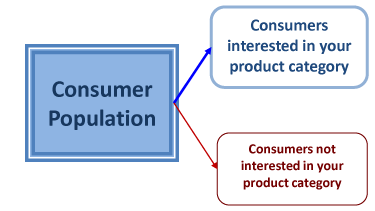
    In the first step you identify “the who”. Who are those consumers in the population who have expressed interest in your product category or who have needs addressed by your product category? In this step you’re simply separating out those interested consumers from the rest of the general population.


    Step 2: Identify your target segments
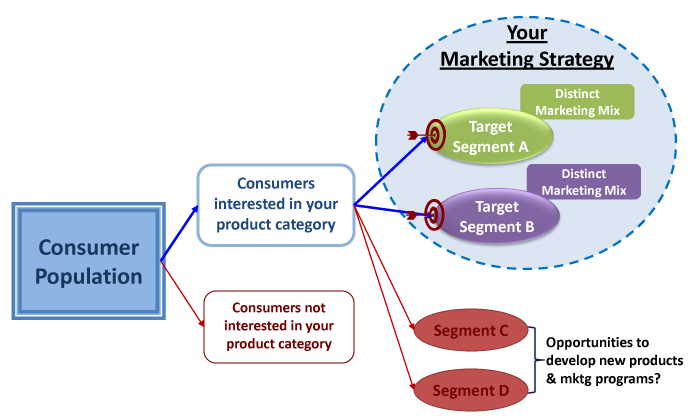
    The second step is where things really get cooking. In step 2 you take the population of interested consumers and group them based upon their similarities with respect to “the what, why, where & how” of your product category.

    In this step your goal is to identify the most attractive segments for your business to target – segments for which the following are true:
    • One or more of your products meet the segment’s functional & emotional needs
    • Your existing channels for selling, servicing & awareness-building align with the segment’s channel preferences and media-consumption habits
    • Your product & brand positioning align with the segment’s “reasons for buying” from both a functional and emotional perspective
    • You can identify the segment in a cost-effective manner
    • The segment is large enough in size and profit-potential to merit investment in a distinct marketing mix
    By the end of step 2, you will have identified one or more segments that:
    • Are interested in one of more of your products
    • Are most effectively targeted using a distinct marketing mix
    • AND, are large enough to merit your investment in this distinct marketing mix

    These segments will become your target segments and along with their distinct marketing mixes represent your marketing strategy. To reiterate from the intro, the beauty of this approach is that by basing part of your segmentation on similarities shared by consumers across key components of your marketing mix, the segments you derive come with their “marketing instructions” already included.


    What about segments you choose not to target?
    So what about segments that don’t meet enough of your targeting criteria? What should you do about them? The answer is that it depends.

    For those segments large enough in size & profit potential you may consider developing new products, building out new channels, or creating communication strategies that better meet their needs and more effectively “speak to them”.

    On the other hand, for those segments that are very small or that would require major retooling of your operations, extensive employee training, or significant stretching of your brand, you would likely leave to other companies to pursue.


    More posts on segmentation & marketing strategy:


    Great books & articles on segmentation:


    read more

    Using segmentation to develop your marketing strategy

    While there are many ways to harness the power of segmentation, one of the broadest and most valuable applications is for designing your marketing strategy – a strategy that clearly defines who you’re targeting, what you’re going to offer them, where you’re going to reach them, and how you’re going to sell them on your product & brand.

    The key “superpower” of segmentation is that it enables you to take a population of consumers and group them based upon similarities they share with respect to the very attributes that you use to define your marketing strategy (i.e., who to target, what to offer them, etc.). What this means is that the segments you derive from the segmentation process will have their preferred marketing mixes already “baked into them”. Powerful stuff.


    Segmentation for designing marketing strategies is a 2-step jig


    Step 1: Identify “the who”

    In the first step you identify “the who”. Who are those consumers in the population who have expressed interest in your product category or who have needs addressed by your product category? In this step you’re simply separating out those interested consumers from the rest of the general population.


    Step 2: Identify your target segments
    The second step is where things really get cooking. In step 2 you take the population of interested consumers and group them based upon their similarities with respect to “the what, why, where & how” of your product category.

    In this step your goal is to identify the most attractive segments for your business to target – segments for which the following are true:
    • One or more of your products meet the segment’s functional & emotional needs
    • Your existing channels for selling, servicing & awareness-building align with the segment’s channel preferences and media-consumption habits
    • Your product & brand positioning align with the segment’s “reasons for buying” from both a functional and emotional perspective
    • You can identify the segment in a cost-effective manner
    • The segment is large enough in size and profit-potential to merit investment in a distinct marketing mix
    By the end of step 2, you will have identified one or more segments that:
    • Are interested in one of more of your products
    • Are most effectively targeted using a distinct marketing mix
    • AND, are large enough to merit your investment in this distinct marketing mix

    These segments will become your target segments and along with their distinct marketing mixes represent your marketing strategy. To reiterate from the intro, the beauty of this approach is that by basing part of your segmentation on similarities shared by consumers across key components of your marketing mix, the segments you derive come with their “marketing instructions” already included.


    What about segments you choose not to target?
    So what about segments that don’t meet enough of your targeting criteria? What should you do about them? The answer is that it depends.

    For those segments large enough in size & profit potential you may consider developing new products, building out new channels, or creating communication strategies that better meet their needs and more effectively “speak to them”.

    On the other hand, for those segments that are very small or that would require major retooling of your operations, extensive employee training, or significant stretching of your brand, you would likely leave to other companies to pursue.


    More posts on segmentation & marketing strategy:


    Great books & articles on segmentation:

    read more

    Snapshot of some of my favorite business books

    So I was in my office today and my Droid was nudging me to take a quick snapshot of a stunning view of some of my favorite business books... it's so hard to say no to a Droid...


    ----------
    read more

    Search Engine Optimization for Dummies and Dummy-Impersonators

    This post is for those of you who see the acronym SEO and feel your throat tighten, your palms begin to sweat, and think to yourself, "ughhh, I know we need this SEO stuff for or to our website, I only wish I knew what SEO stood for!.." (And no, you're far from a dummy if you find SEO confusing - I used this title purely to help my Google page rank for this post ;) 

    No matter how confused you ever become about Search Engine Optimization, if you remember the following you will always be able to reorient yourself and make a quick "recovery":

    Google is just a librarian and SEO is simply good book labeling.
    [say what?]


    Google is just a librarian...
    Think of Google as the head librarian of our 21st century digital library - a library filled with all the world's websites, including yours.

    Google's job is simply to provide its patrons (i.e., users of its search engine) with the best information on the topics they are searching for, usually provided in the form of website links, images or videos.

    For example, let's say a nice, eligible bachelor named Larry wants to find out what he can do to "tame" his fiery dragon breath and make it past date #1. Larry comes up to the library counter (i.e., www.google.com) and asks Google for information about Halitosis. Google, at lightning speed, runs to the Halitosis section of the "library", and grabs ALL of the websites on Halitosis. When Google returns to the counter, she places all of the Halitosis sites in front of Larry, sorting them from most relevant & most popular to least relevant & least popular.

    That is Google's search engine in a nutshell.  (And yes, it was recently revealed by the company that Google's search engine is in fact female)


    ...SEO is simply good book labeling
    So how does SEO come into play within this "digital library" of all the world's websites?  

    Think of SEO as the process of effectively labeling & categorizing your website so that Google understands what your site is about and therefore knows when to include it as part of a person's search results.  

    Going back to our Halitosis example, imagine there are 2 websites on the topic of bad breath.  Site A's name is, "How to Eliminate Bad Breath", and site B's is, "Fighting the Enemy One Brush at a Time". 

    The main sections of site A (think titles of book chapters) include definitively breath-related headings like "Where bad breath comes from", "Top tips for beating Halitosis" and "Why brushing alone won't prevent bad breath".  In contrast, the main sections of site B include somewhat vague, albeit more humorous headings such as, "Readying for battle", "Exorcising your tongue", and "The war within". 

    Which of these 2 websites do you think Google would rank higher on the list of Halitosis sites it returns to our eligible, yet breath-challenged bachelor?  Unfortunately it's not the site with the more creative copywriter.  Sorry. 

    Google's no poet, so easy on the metaphors
    While Google is one heck of a librarian, she's not a mind reader - at least not yet.  In other words, you need to be extremely clear and literal with your website content, especially when it comes to major headings & titles.  

    Think of it this way - if you're thumbing through a book trying to figure out what it's about, you're most likely going to look at the book's cover, leaflets, chapter names, and index.  Google ""thumbs through" your website in much the same way.  So cute and overly metaphoric titles like "Making it to date #2"  will only help drag your site's Google ranking down... and with it, your website traffic.

    Now that you hopefully have a better 50,000-foot view of SEO, below are a few resources that I've found to be particularly insightful for SEO newbies. 


    GODZILLA ILLUSTRATION: TANYA DASHEVSKY
       

    Additional SEO sources for beginners looking to get a little dirt on their hands
        read more

        Search Engine Optimization for Dummies and Dummy-Impersonators

        This post is for those of you who see the acronym SEO and feel your throat tighten, your palms begin to sweat, and think to yourself, "ughhh, I know we need this SEO stuff for or to our website, I only wish I knew what SEO stood for!.." (And no, you're far from a dummy if you find SEO confusing - I used this title purely to help my Google page rank for this post ;) 

        No matter how confused you ever become about Search Engine Optimization, if you remember the following you will always be able to reorient yourself and make a quick "recovery":

        Google is just a librarian and SEO is simply good book labeling.
        [say what?]


        Google is just a librarian...
        Think of Google as the head librarian of our 21st century digital library - a library filled with all the world's websites, including yours.

        Google's job is simply to provide its patrons (i.e., users of its search engine) with the best information on the topics they are searching for, usually provided in the form of website links, images or videos.

        For example, let's say a nice, eligible bachelor named Larry wants to find out what he can do to "tame" his fiery dragon breath and make it past date #1. Larry comes up to the library counter (i.e., www.google.com) and asks Google for information about Halitosis. Google, at lightning speed, runs to the Halitosis section of the "library", and grabs ALL of the websites on Halitosis. When Google returns to the counter, she places all of the Halitosis sites in front of Larry, sorting them from most relevant & most popular to least relevant & least popular.

        That is Google's search engine in a nutshell.  (And yes, it was recently revealed by the company that Google's search engine is in fact female)


        ...SEO is simply good book labeling
        So how does SEO come into play within this "digital library" of all the world's websites?  

        Think of SEO as the process of effectively labeling & categorizing your website so that Google understands what your site is about and therefore knows when to include it as part of a person's search results.  

        Going back to our Halitosis example, imagine there are 2 websites on the topic of bad breath.  Site A's name is, "How to Eliminate Bad Breath", and site B's is, "Fighting the Enemy One Brush at a Time". 

        The main sections of site A (think titles of book chapters) include definitively breath-related headings like "Where bad breath comes from", "Top tips for beating Halitosis" and "Why brushing alone won't prevent bad breath".  In contrast, the main sections of site B include somewhat vague, albeit more humorous headings such as, "Readying for battle", "Exorcising your tongue", and "The war within". 

        Which of these 2 websites do you think Google would rank higher on the list of Halitosis sites it returns to our eligible, yet breath-challenged bachelor?  Unfortunately it's not the site with the more creative copywriter.  Sorry. 

        Google's no poet, so easy on the metaphors
        While Google is one heck of a librarian, she's not a mind reader - at least not yet.  In other words, you need to be extremely clear and literal with your website content, especially when it comes to major headings & titles.  

        Think of it this way - if you're thumbing through a book trying to figure out what it's about, you're most likely going to look at the book's cover, leaflets, chapter names, and index.  Google ""thumbs through" your website in much the same way.  So cute and overly metaphoric titles like "Making it to date #2"  will only help drag your site's Google ranking down... and with it, your website traffic.

        Now that you hopefully have a better 50,000-foot view of SEO, below are a few resources that I've found to be particularly insightful for SEO newbies. 


        GODZILLA ILLUSTRATION: TANYA DASHEVSKY
           

        Additional SEO sources for beginners looking to get a little dirt on their hands
            read more

            "Would you like a coke with your product-sandwich?"

            How many times have you been asked the above question at your local wine store?

            "Huh?" you say.... okay, so maybe you weren't asked the question explicitly... instead it was embedded in the array of differently priced wines displayed throughout the shop.

            For those of you who, like me, know little about wine, when was the last time you went into a wine store and bought the cheapest wine on the shelf? When was the last time you bought the most expensive wine on the shelf? My guess is that most of you can't recall the last time you did either because when you go to the wine store you "play it safe" and usually buy a wine priced "somewhere in the middle". I know I do.

            Little did you realize that your local wine store was employing a product-sandwich strategy, drawing you helplessly towards that mid-priced bottle of wine! And you thought you were in control! :)


            What is a Product-Sandwich Strategy?
            In a nutshell, the strategy involves creating/selling a (very) high-priced version of your product so that the next price down appears more moderate in comparison. Often times this "next price down" would be considered expensive by the customer in absolute terms, but in relative terms (i.e., next to your "Rolls Royce" model) it appears reasonably priced. If implemented successfully, the net impact on your business is a boon in sales of the mid-priced version.


            Why does the Product-Sandwich Strategy work?
            The Product-Sandwich strategy is based on the principle that when buying an unfamiliar product or service people tend to purchase a mid-priced version of it. Why? It all comes down to risk aversion - fear of making a bad purchase and flushing money down the toilet bowl. This toilet-bowl-infused aversion is the reason we shy away from the pricey models ("How much better could that stereo possibly sound?") and reject the cheap ones ("I bet this stereo would die after a month!").


            Can I use a Product-Sandwich Strategy in my business?
            Businesses that sell hard-to-value goods (e.g., perfume, body lotion, wine, caskets), or whose target customers tend to be product novices are generally best suited for a Product-Sandwich strategy.
            • Think selling perfume to people who don't know the difference between eau de toilette and the water in their toilets.
            • Or selling car oil to someone who doesn't happen to have a name embroidered on his shirt.

            Make sure customers are made aware of the range of price points
            One critical success factor for any product sandwich strategy is to ensure that your customers are aware of the different price points of your products, most notably your high-priced version. It is this awareness that leads your customers to view the mid-priced products as the mid-priced products, and hence the "safe, yet reasonable choice".


            What do you think?

            Have you ever employed a product-sandwich or similar such strategy? If so, how successful was it? What did you learn? What worked? What didn't work?

            What ethical issues, if any, does this bring up for you? Do you view this as psychological manipulation or just good, plain marketing strategy?

            Please share your experiences, comments, thoughts or questions.


            Additional info sources on Product-Sandwich strategy & the psychology behind it

            ...and for those who really hate wine stores & happen to have iPhones

            read more

            "Would you like a coke with your product-sandwich?"

            How many times have you been asked the above question at your local wine store?

            "Huh?" you say.... okay, so maybe you weren't asked the question explicitly... instead it was embedded in the array of differently priced wines displayed throughout the shop.

            For those of you who, like me, know little about wine, when was the last time you went into a wine store and bought the cheapest wine on the shelf? When was the last time you bought the most expensive wine on the shelf? My guess is that most of you can't recall the last time you did either because when you go to the wine store you "play it safe" and usually buy a wine priced "somewhere in the middle". I know I do.

            Little did you realize that your local wine store was employing a product-sandwich strategy, drawing you helplessly towards that mid-priced bottle of wine! And you thought you were in control! :)


            What is a Product-Sandwich Strategy?
            In a nutshell, the strategy involves creating/selling a (very) high-priced version of your product so that the next price down appears more moderate in comparison. Often times this "next price down" would be considered expensive by the customer in absolute terms, but in relative terms (i.e., next to your "Rolls Royce" model) it appears reasonably priced. If implemented successfully, the net impact on your business is a boon in sales of the mid-priced version.


            Why does the Product-Sandwich Strategy work?
            The Product-Sandwich strategy is based on the principle that when buying an unfamiliar product or service people tend to purchase a mid-priced version of it. Why? It all comes down to risk aversion - fear of making a bad purchase and flushing money down the toilet bowl. This toilet-bowl-infused aversion is the reason we shy away from the pricey models ("How much better could that stereo possibly sound?") and reject the cheap ones ("I bet this stereo would die after a month!").


            Can I use a Product-Sandwich Strategy in my business?
            Businesses that sell hard-to-value goods (e.g., perfume, body lotion, wine, caskets), or whose target customers tend to be product novices are generally best suited for a Product-Sandwich strategy.
            • Think selling perfume to people who don't know the difference between eau de toilette and the water in their toilets.
            • Or selling car oil to someone who doesn't happen to have a name embroidered on his shirt.

            Make sure customers are made aware of the range of price points
            One critical success factor for any product sandwich strategy is to ensure that your customers are aware of the different price points of your products, most notably your high-priced version. It is this awareness that leads your customers to view the mid-priced products as the mid-priced products, and hence the "safe, yet reasonable choice".


            What do you think?

            Have you ever employed a product-sandwich or similar such strategy? If so, how successful was it? What did you learn? What worked? What didn't work?

            What ethical issues, if any, does this bring up for you? Do you view this as psychological manipulation or just good, plain marketing strategy?

            Please share your experiences, comments, thoughts or questions.


            Additional info sources on Product-Sandwich strategy & the psychology behind it

            ...and for those who really hate wine stores & happen to have iPhones

            read more